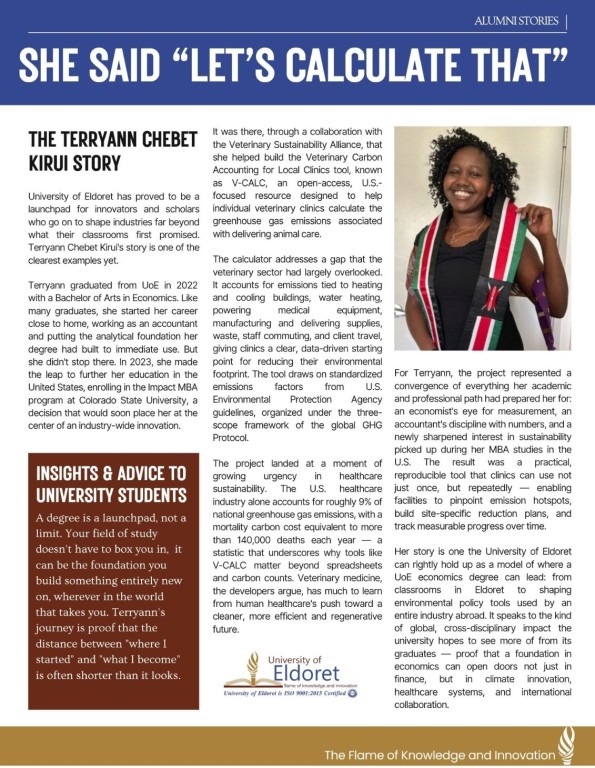

University of Eldoret has proved to be a launchpad for innovators and scholars who go on to shape industries far beyond what their classrooms first promised. Terryann Chebet Kirui's story is one of the clearest examples yet.
Terryann graduated from UoE in 2022 with a Bachelor of Arts in Economics. Like many graduates, she started her career close to home, working as an accountant and putting the analytical foundation her degree had built to immediate use. But she didn't stop there.
In 2023, she made the leap to further her education in the United States, enrolling in the Impact MBA program at Colorado State University — a decision that would soon place her at the center of an industry-wide innovation.
Insights & Advice to University Students
A degree is a launchpad, not a limit. Your field of study doesn't have to box you in — it can be the foundation you build something entirely new on, wherever in the world that takes you. Terryann's journey is proof that the distance between "where I started" and "what I become" is often shorter than it looks.
It was there, through a collaboration with the Veterinary Sustainability Alliance, that she helped build the Veterinary Carbon Accounting for Local Clinics tool — known as V-CALC — an open-access, U.S.-focused resource designed to help individual veterinary clinics calculate the greenhouse gas emissions associated with delivering animal care.
V-CALC Veterinary Carbon Accounting for Local Clinics
An open-access tool for calculating greenhouse gas emissions in veterinary care
The calculator addresses a gap that the veterinary sector had largely overlooked. It accounts for emissions tied to:
- Heating and cooling buildings
- Water heating
- Powering medical equipment
- Manufacturing and delivering supplies
- Waste management
- Staff commuting
- Client travel
This gives clinics a clear, data-driven starting point for reducing their environmental footprint. The tool draws on standardized emissions factors from U.S. Environmental Protection Agency guidelines, organized under the three-scope framework of the global GHG Protocol.
9% of U.S. national greenhouse gas emissions come from the healthcare industry
The project landed at a moment of growing urgency in healthcare sustainability. The U.S. healthcare industry alone accounts for roughly 9% of national greenhouse gas emissions, with a mortality carbon cost equivalent to more than 140,000 deaths each year — a statistic that underscores why tools like V-CALC matter beyond spreadsheets and carbon counts.
Veterinary medicine, the developers argue, has much to learn from human healthcare's push toward a cleaner, more efficient and regenerative future.
"For Terryann, the project represented a convergence of everything her academic and professional path had prepared her for: an economist's eye for measurement, an accountant's discipline with numbers, and a newly sharpened interest in sustainability picked up during her MBA studies in the U.S."
The result was a practical, reproducible tool that clinics can use not just once, but repeatedly — enabling facilities to pinpoint emission hotspots, build site-specific reduction plans, and track measurable progress over time.
A Model of Global Impact
Terryann's story is one the University of Eldoret can rightly hold up as a model of where a UoE economics degree can lead: from classrooms in Eldoret to shaping environmental policy tools used by an entire industry abroad.
It speaks to the kind of global, cross-disciplinary impact the university hopes to see more of from its graduates — proof that a foundation in economics can open doors not just in finance, but in climate innovation, healthcare systems, and international collaboration.
Image Gallery